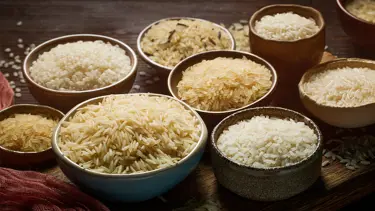
Types of rice
Rice is the edible seed of a grass and one of the most widely consumed foods in the world. It feeds roughly half the planet, and it is a cooking staple across Asia, the Middle East, Africa, Latin America, and southern Europe. One of its greatest strengths is variety, with different rice types offering distinct textures and cooking characteristics.
Below, we will delve into each of these types of rice, along with wild rice, which is technically the seed of a separate grass but is cooked in a similar way. Learn everything you need to know about varieties like basmati, jasmine, Carolina, Arborio, Calrose, sushi rice, and many more.
Key takeaways about rice types
- Rice is sorted mainly by grain length, long, medium, and short, which determines whether it cooks light and separate, creamy, or sticky.
- Long-grain varieties include aromatic types like basmati and jasmine, and plainer ones like Carolina.
- Medium-grain rice, like Arborio and Calrose, is prized for its creamy, clinging texture, while short-grain rice, like sushi rice, is the stickiest.
- Wholegrain rice, such as brown and black rice, keeps its bran and germ layers, while parboiled rice is treated to cook up firmer.
- Wild rice is not a true rice at all, but a North American grass seed with a longer, chewier grain.
- Cooking method and ratio matter as much as the rice itself, and storage life varies by type.
What are long-grain rice varieties?
Long-grain rice is the slimmest type of rice, measuring 6-7mm in length. The grains are around 3-5 times longer than they are wide, and they cook into light, separate grains rather than a soft mass. This comes down to starch. Long-grain rice is high in amylose, the starch that keeps grains sticking to one another, so they stay distinct and dry once cooked.
Long-grain rice varieties include basmati and jasmine, the two most widely known aromatic types. Plainer non-aromatic rice like Carolina falls into this group too, along with regional Indian varieties such as Sona Masoori, Ponni, and Matta. These range from soft and delicate to firm and robust.
Basmati rice
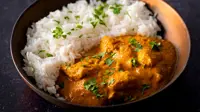
Basmati is the celebrated aromatic long-grain rice of India and Pakistan. It has slender grains and an unmistakable scent often likened to popcorn or freshly baked bread.
What most sets it apart from ordinary long-grain rice is the way it lengthens. The grains stretch to nearly double their raw length as they cook while staying thin, producing the long, needle-like strands.
The scent comes from a natural aroma compound that the grain carries in far higher amounts than plain rice, which, by comparison, has a very neutral aroma. Cooked well, basmati stays firm and separate rather than gluey, which is exactly why it is central to South Asian cooking.
Length: 6.6-7mm raw, extending to around double when cooked
Taste: Nutty and fragrant, with a subtle natural sweetness
Texture: Firm, dry, and separate, with grains that stay distinct
Best for: Biryani, curries, and pilafs, where individual grains are meant to show
Jasmine rice
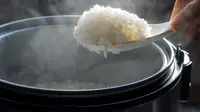
Jasmine rice is a fragrant long-grain rice from Thailand, named after the sweet, floral scent it gives off as it steams. It is especially popular in Thai cuisine, but it is also used for everyday cooking across much of Southeast Asia. The grains are long and slim, though a touch shorter and rounder than basmati, and they behave differently once cooked.
Rather than staying bone-dry and fully loose, jasmine turns soft and moist, while the grains cling together just enough to gather easily on a spoon or with chopsticks. Its mild, faintly sweet flavour works well alongside bolder, spicier dishes.
Length: 6-7mm raw, extending slightly to around 8-9mm when cooked
Taste: Mild and faintly sweet
Texture: Soft and moist, with grains that cling together lightly
Best for: Thai curries, stir-fries, grilled meats, and chicken-and-rice dishes such as khao man gai.
Carolina rice
Carolina rice is light and fluffy when cooked. It has a mild, lightly nutty flavour, and the grains fall apart cleanly rather than clumping. This neutral character makes it an all-rounder, equally at home as a side dish or as a base for other flavours.
It takes its name from the Carolina Lowcountry of the American southeast, where the heirloom variety known as Carolina Gold was once the most important rice in the country. Nearly lost during the twentieth century, it has been brought back in recent decades.
Length: 6-8mm raw, extending slightly when cooked
Taste: Mild and lightly nutty, with a neutral taste
Texture: Light and fluffy, with grains that separate cleanly
Best for: Everyday side dishes, casseroles, stuffings, stir-fries, and pilafs
What are medium-grain rice varieties?
Medium-grain rice sits between the long and short types at around 5-6mm. The kernels are plump, roughly 2-3 times as long as they are wide. Cooked, it turns moist, tender, and a little sticky, with a soft creaminess that neither long-grain nor small-grain types quite match.
This comes down to the rounder shape and the starch balance inside the grain. Long-grain rice stays dry and separate because its slim kernels hold on to their starch, whereas medium-grain rice releases more starch, so the grains cling gently and the cooking liquid thickens around them. That is why these varieties work great for risotto and paella, where the grains need to stay creamy on the outside but keep some bite.
Most medium-grain varieties belong to the Japonica branch of the rice family, which tends to produce shorter, rounder, stickier grains. Arborio is the best known, prized for the creamy risotto it produces, while Calrose is the everyday medium-grain rice grown widely in the United States.
Arborio rice and other risotto rice
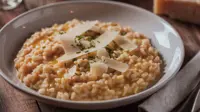
Arborio is an Italian medium-grain rice typically used for risotto. Each grain has a small white dot at its centre, which is the key to how it cooks. Arborio is high in amylopectin, the starch that dissolves into the liquid as you stir. It gives risotto its thick, flowing creaminess without a drop of cream added.
The white core absorbs liquid more slowly than the outer layers, which is why a properly cooked risotto is creamy on the outside yet keeps a firm, slightly chewy bite in the middle.
Carnaroli and Vialone Nano are two well-known relatives of Arborio. Carnaroli holds its shape better and is more forgiving of overcooking, which has earned it the nickname "king of risotto rice." Vialone Nano cooks looser and more fluid, with tender grains that ripple across the plate. All three rely on the same starch for their creaminess and differ mainly in how firm the grain stays and how thick the sauce turns out. For more on the technique, see our guide to creamy risotto.
Length: 6.5-7.6mm, with only modest lengthening when cooked
Taste: Mild and faintly milky, taking on the flavours cooked into it
Texture: Creamy and smooth on the outside, firm and slightly chewy at the core
Best for: Risotto, rice pudding, and soups
Calrose rice
Calrose is a medium-grain variety of the Japonica type and cooks soft, moist, and slightly sticky. It has little of the starch that keeps grains firm and separate, so the cooked grains cling together and hold their shape well. This makes it clump just enough to be gathered into sushi rolls or nigiri, and it holds together firmly in rice balls and packed portions without falling apart.
It was developed in California in 1948 and is still the main medium-grain rice grown in the United States. The name blends "Cal" for California and "rose" for the rounded shape of the grain.
Length: Around 5-6mm raw, extending only slightly when cooked
Taste: Mild and clean, with little aroma of its own
Texture: Soft, moist, and slightly sticky, holding its shape when pressed
Best for: Sushi, rice balls, bento portions, and everyday table rice
What are short-grain rice varieties?
Short-grain rice varieties are 4–5mm long, almost round, plump grains that are less than twice as long as they are wide. They cook into soft, sticky, clumpy rice, and that stickiness is what makes them useful whenever rice needs to hold together rather than stay separate. Sushi relies on it to keep rolls and nigiri in shape, and rice desserts like pudding depend on the same soft, clinging texture.
Bomba and Valencia are the classic Spanish varieties used for paella. Both are short-grain, but they behave quite differently from the rest. They soak up around twice as much liquid as long-grain rice, but the grains stay separate rather than sticky.
Sushi rice
Sushi rice is a short-grain Japanese rice, seasoned after cooking with rice vinegar, sugar, and salt. This gives it the mild tang and glossy, pliable texture that shapes so neatly by hand. The grains are short, round, and plump, and high in the sticky starch that forms a light gel on the surface as they cook. The gel lets the grains stick together firmly enough to hold their shape, while still coming apart easily when bitten into. The best-regarded varieties include Koshihikari, Sasanishiki, and Akita Komachi.
Length: 4-5mm raw, extending only slightly when cooked
Taste: Mild rice flavour with a subtle sweet-and-sour seasoning
Texture: Soft, sticky, and easy to shape, yet it comes apart easily when bitten into
Best for: Sushi, nigiri, maki rolls, and rice balls
What is wholegrain and processed rice?
Wholegrain and processed rice are grouped by how the grain is processed after harvest, rather than by its length.
Wholegrain rice, like brown or black rice, keeps its bran and germ layers, giving it more fibre, a firmer texture, and a nuttier flavour than white rice.
Processed rice has had those layers milled away entirely to make white rice, or altered through methods like parboiling, which steams the grain in its husk before milling to firm up the starch.
Parboiled rice
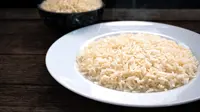
Parboiled rice is partly cooked in its husk before it is milled. The grain is soaked, then pressure-steamed until its starch sets, and finally dried and milled like any other rice. Steaming firms up the starch and shifts some of the grain's nutrients toward the centre, so the finished rice cooks into separate, resilient grains that are hard to overcook.
It is easy to spot by its faint golden tint, which sets it apart from the pure white of untreated rice. It also releases its sugars more slowly than standard white rice once eaten, and holds together better during cooking, with fewer grains breaking apart.
Length: Ranges from 4-5mm (short-grain) to 5-6mm (medium-grain) to 6-7mm (long-grain), depending on variety
Taste: Mild, with a faintly nutty note
Texture: Firm and distinctly separate, resistant to going soft
Best for: Pilafs, casseroles, stuffings, and dishes where separate grains matter
Brown rice
Brown rice keeps its bran and germ layers after the husk is removed, which gives it a tan colour and wholegrain character. Because those layers stay in place, it holds far more of the grain's fibre, vitamins, and minerals than white rice, along with a firmer texture and a mild, nutty flavour.
The trade-off is time. The intact bran resists water, so brown rice takes noticeably longer to cook and needs more liquid than a white grain of the same variety. It also keeps for less time in the cupboard, since the natural oils in the germ eventually go bad.
Length: Ranges from 4-5mm (short-grain) to 5-6mm (medium-grain) to 6-7mm (long-grain), depending on variety
Taste: Mild, nutty, and earthy
Texture: Firm and chewy, with more bite than white rice
Best for: Grain bowls, stir-fries, casseroles, stuffings, and pilafs
Black rice
Black rice is a wholegrain rice whose bran layer is a deep black-purple. Cooked, the grains soften and turn dark purple. They have a mild, slightly sweet, nutty flavour and a texture that is a little softer than brown rice.
The rice suits both savoury dishes and puddings, where its deep colour stands out on the plate. And it is sometimes referred to as "forbidden rice," a name tied to its history in ancient China, where it was rare, highly prized, and associated with nobility.
Length: Ranges from 4-5mm (short-grain) to 5-6mm (medium-grain) to 6-7mm (long-grain), depending on variety
Taste: Mild, sweet, and nutty, earthier than white rice
Texture: Tender, a little softer than brown rice, with a slight chew from the bran
Best for: Grain bowls, salads, puddings, and dishes where its colour stands out
What is wild rice?
Wild rice is not actually rice at all, but the seed of a group of tall water grasses that grow in the lakes and rivers of North America. It looks and cooks enough like true rice to be treated as one in the kitchen. True rice comes from the genus Oryza, whereas wild rice belongs to Zizania. The two are cousins within the wider grass family rather than the same plant, and they behave quite differently on the plate.
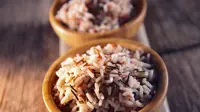
You can tell it apart at a glance. The grains are long and slim, ranging from deep brown to an almost black-purple. They look far more needle-like than ordinary white or brown grain. Cooked, wild rice has a pronounced nutty, earthy flavour. The texture sets it apart just as clearly, firm and chewy with a slight spring, and grains that stay separate rather than turning soft or sticky. It takes longer to cook than most true rice types.
Length: Around 10-20mm raw, longer than any true rice variety
Taste: Strong, nutty, and earthy
Texture: Firm, chewy, and springy, with grains that stay separate
Best for: Soups, salads, stuffings, pilafs, and rice blends
How to cook rice
Rice is cooked by boiling it in a measured amount of water until the grains absorb the liquid and turn tender. You can either use the absorption method or the rapid-boil method to cook your rice. Timing varies from one rice type to the next, but two things matter whichever method you use:
- Get the water-to-rice ratio right
- Keep the lid on while it steams
The standard ratio is two parts water to one part rice, so 600ml of water to 250g (300ml) of rice feeds about four, with a pinch of salt added to the pot. Allow 50-60g of uncooked rice per person, since the grains roughly double in size as they cook.
Absorption method: Bring the measured water to the boil, add rice and salt, then cover, turn the heat right down, and simmer for around 10 minutes. Take it off the heat and let it stand, still covered, for another 10 minutes. Do not lift the lid, as every peek lets out the heat and steam the rice needs. Fork it through at the end to separate the grains. Exact timings and ratios vary by rice type, as shown in the table below.
|
Rice type |
Water-to-rice ratio |
Simmer time (covered) |
Rest time (off heat) |
|---|---|---|---|
|
White long-grain (basmati, jasmine) |
2:1 |
10–12 minutes |
10 minutes |
|
White medium-grain (Calrose) |
2:1 |
15 minutes |
10 minutes |
|
White short-grain (sushi rice) |
1½:1 |
15 minutes |
10 minutes |
|
Parboiled (easy-cook) white |
2½:1 |
20–25 minutes |
5 minutes |
|
Brown rice (any grain length) |
2½:1 |
25–30 minutes |
10 minutes |
|
Black rice |
2½:1 |
30–35 minutes |
10 minutes |
Times and ratios are guides. Actual timing varies by brand, grain age, and pot, so check towards the end and adjust in your next batch.
Rapid-boil method ("pasta" method): Treats rice more like pasta and suits longer grains such as basmati especially well. Rinse the rice several times and soak it for around 30 minutes, then drain and tip it into a large pot of boiling water, cooking it uncovered for 5-6 minutes. Drain it, return it to the warm pot with the lid on for a few minutes to steam, then fork it through. Wild rice is usually cooked this way rather than by absorption, since it needs plenty of water and around 45-50 minutes to soften. For more on the basics of boiling white rice this way, see this guide on how to cook rice.
Find easy rice recipes
The best way to get to know rice is to cook it. Here are a few recipes you can try.
A saffron risotto is the place to start for creamy comfort. Its golden grains cooked slowly until smooth and rich, equally good as a refined starter or a quiet supper. And arancini balls put any leftover risotto to work, rolled into crisp, fried bites with a molten cheese centre.
For everyday cooking, chicken kabsa takes a fast one-pot route, everything simmered together with a bright spice mix. For more ideas, see our five chicken and rice recipes from around the world.
FAQ: Questions about rice types
Still have a few questions about rice types? Below are answers to some of the most common ones, from choosing the right grain for a light, fluffy result or a creamy one to keeping your rice fresh for as long as possible. A little know-how goes a long way towards getting the best from whichever type you cook.
-
The best rice for fluffy rice is a long-grain variety like basmati. Long-grain rice is high in amylose, the starch that keeps grains from sticking, so it cooks dry and without clumping. Basmati does this best of all. Its slender grains stay firm and separate, which is why it suits pilafs, curries, and biryani. Rinsing the rice before cooking helps, too, as it washes away the loose surface starch that would otherwise make the grains cling.
-
The best rice for a creamy texture is a medium-grain variety like arborio. This type is high in amylopectin, the starch that dissolves into the cooking liquid and thickens it, giving dishes such as risotto their smooth, flowing body. Carnaroli and Vialone Nano do the same job and are prized for risotto as well. The technique matters as much as the grain, since stirring the rice as it cooks is what draws out the starch and builds creaminess.
-
Store rice in an airtight container somewhere cool, dark, and dry, though how long each keeps varies. White, parboiled, and other milled rice lasts the longest, staying good for a year or more in an airtight container in a cool, dark, dry cupboard. Wholegrain rice, such as brown, black, and wild rice, keeps for less time, usually around six months, because the natural oils in their intact bran eventually turn bad. Storing those in the fridge or freezer extends their life. Cooked rice of any type should be cooled quickly, refrigerated within an hour, and kept no longer than 4 days.
MASTERING RICE
Discover the tricks and turn your everyday rice dishes into something extraordinary.
GET COOKING